
Screw Air Compressors
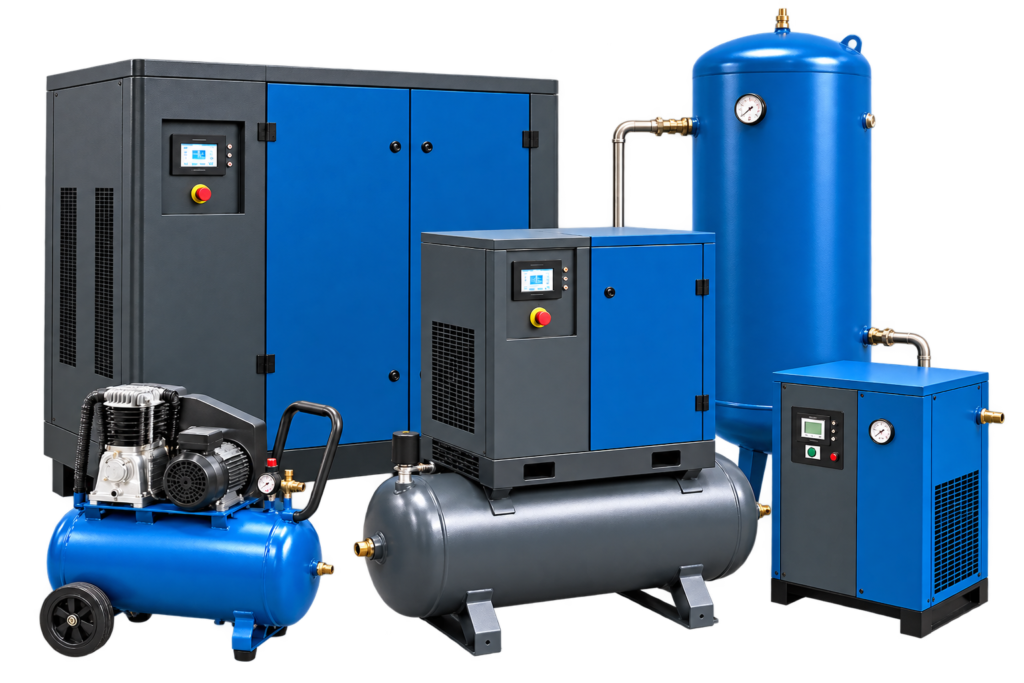
At Griffin Air Systems, we supply and install high-performance screw air compressors and air compressors screw type models designed for workshops, factories, and industrial applications across Scotland.
How Do Rotary Screw Air Compressors Work?
Rotary screw air compressors are powerful and efficient machines that can be used in a range of environments, such as manufacturing plants, construction sites, and automotive workshops. Composed of two interlocking helical rotors, they compress the air via positive displacement. As the rotors rotate, the air is drawn in and trapped, reducing volume and increasing pressure.
Working with a continuous cycle, screw compressors are known for being able to reliably deliver a constant supply of compressed air, thus improving operation efficiency. With their high output, durability, low maintenance requirements, and energy efficiency, rotary screw air compressors have become indispensable tools in modern industrial operations.
Key Benefits of Screw Type Air Compressors
Continuous operation without overheating
High efficiency for reduced energy bills
Low noise output compared to traditional piston compressors
Durability with fewer moving parts for less wear and tear
Compact design for space-constrained workshops
Industrial Screw Type Air Compressors
For large-scale operations, screw air compressors provide the power and efficiency you need to keep production lines running.
Applications include:
-Manufacturing plants requiring high-volume, continuous airflow
-Food and beverage processing, where clean and reliable air is essential
-Automotive workshops needing powerful, durable screw drive air compressors
-Pharmaceutical and healthcare environments that demand oil-free air
With Griffin Air Systems, you’ll receive professional guidance to choose the right compressor for your specific industry requirements.
Air Compressor Screw FAQs
How does a screw type air compressor work?
A screw air compressor operates on the principle of positive displacement. It consists of two helical shape male and female rotors, or screws, that intermesh closely within a sealed chamber. As the rotors rotate, the air is drawn into the compressor through the inlet port. The air then gets trapped in the space between the rotors and the compressor housing, progressively compressing the air. The volume of the chamber decreases as the rotors rotate, leading to the compression of the trapped air. The compressed air is then discharged through the outlet port.
Does a rotary screw compressor need a tank?
Yes, a rotary screw air compressor requires a tank to store the compressed air it generates. The tank serves several important functions, including stabilising the air pressure, accommodating sudden demand surges, separating moisture from the compressed air, and improving energy efficiency. While there are some variations of screw compressors that can operate without a tank (known as tankless or base-load compressors), having a tank offers numerous advantages in terms of performance, stability, and operational efficiency.
Can screw compressors be repaired?
Yes, rotary screw air compressors can be repaired. Like any mechanical system, they can experience wear and tear, component failures, or operational issues over time. The repair process typically involves diagnosing the problem, identifying the faulty components, and replacing or repairing them as necessary. Common repair tasks for rotary screw air compressors may include changing oil and filters, replacing worn or damaged parts, such as seals, bearings, belts, and valves, or replacement of worn sensors.